When you are traveling in another country, it is important the room is locked properly. Most mid and high-end hotels accomodate magnetic strip key cards. Some hotels transfer credit cards into room cards for the convenience of customers. With the increasing demand for higher security, suppliers are responsible for providing the best locking system for hotel guests. Room keys not only have to be easy to use, but aesthetically pleasing for the guests. “Contactless locking solutions that rely on radio frequency identification (RFID) technology and near field communication (NFC) cell phone compatibility are two solutions that are poised to be the next innovations in door-locking security.” With the RFID, it only requires guests to hold up a key card, wristband, or fob to the reader in order to gain access into the room. This prevents occurrences of key card demagnetization. The device is simple and easy to use for the guests. Another option is using a NFC-enabled cell phone to unlock the room. This is prevalent in Europe and Asia. “NFC is a short-range high frequency wireless communication technology which enables the exchange of data between devices over a distance of about 4 inches.
Quickness and easiness is not the only good part about these devices. RFID and NFC allow guests to skip the check-in line upon arrival and go straight to their rooms, using their cell phones to unlock the room. Upon arrival, guests will receive a short message which includes a booking confirmation and room number, with an encrypted room key access code that unlocks their door with their cell phone. Also at the end of their stay, guests can use their cell phones to check-out through an NFC-enabled in-room television or an NFC-enabled hotel kiosk. There is no need to stop at the front desk to check-in or check-out.
FoneKey, VingCard, and Kaba Ilco are one of the suppliers that offer this service. VingCard offers RFID lock at The Plaza in New York City. Regal Enclave and Executive Enclave in Mumbai, India are using this system. Guests love new technological tools. When it is easy and quick, guests will love more. By providing better service for guests, hotels are able to advertise themselves to the world. Sooner or later, FoneKey will be expanding its services to many hotels in the states.
Hotels Lock It Up by Christina Volpe
Sunday, October 26, 2008

Saturday, October 18, 2008
Forget the Front Desk: Hotels go High Tech

Life just gets easier and easier. Would you like to know more about your gests, increase customer satisfaction, and boost sales at the same time?
Rutriz, a software firm in California, is aiming to bring hotels up to speed. They have launched a product called “Hotel Evolution” at the Malibu Beach Inn in Malibu, California. When a guest checks into the hotel, they are asked if they have an iPhone or iPod Touch. If they do, the hotel staff will load the Runtriz Hotel web application to the device, If they don’t they are given a 16GB iPod Touch to keep for the duration of their stay.
All you have to do is punch in your room number and security code, and you are all set. Straight from the device’s screen, you can order room service, set a wake up call, request your luggage, dry cleaning, linens or toiletries, check your messages, or set your room to “Do Not Disturb.” It also provides information about nearby nightlife, attractions, shopping. The device is not hard to use because it works just like the iPhone or iPod Touch. It is a touch screen, so the guests do not have to wait for anything.
The hotel does not have to go through each iPod and update whenever they have additions. They can simply upgrade and maintain the application by modifying the site. You no longer have to have bunch of papers flying around. Hotel Evolution will simply update all the information about your customers on the reports. It is also eco-friendly because it eliminates the use of papers for brochures, menus, booklets, hotel directories, and so on.
This is just the start of technology, but possibilities of improvement are enormous. iPhone will not be the only device that hotels will use. In the future, Runtriz is planning to install the software on Blackberry and labtops. In the later days, the hotel might not need anyone at the front desk. Customers can simply type on their iPhone and everything will be set the moment they arrive at the airport. Most people carry phones with them anyways, so why not make their phone into a device they can use at the hotel?
Sunday, October 12, 2008
Effects on the Wall


Biggest meeting industry trend is increasing use of technology. People love looking at new technology. In order to make a striking first impression, there is no better way than catching the group’s attention. Meeting planners are evolving to provide more creative tools to customers. “Projecting images through a wall of water is one effect meeting planners can now use to wake up jaded delegates. At the recent BET (Black Entertainment Awards) more than half of the 13 acts included some form of pyro, gas flames, cryogenics, fog, or water curtains.” These are used for great entrances and exits through laser or video-projected company logos. “The water screens work by creating a thin film of water ideal for rear projection of videos, laser, gobos, and other lighting effects.”
The scale of the event increases when the company uses various kinds of walls. When setting up an event, the meeting planner has a certain amount of budget that one has to manage. Setting up these high-tech screens can only be used in big events due to the cost of it. Prina offers seven-foot section with a screen, ejector, tank, hose, water pumps, and filtration system that can be rented for $2,300 a day.
It sure would be an eye-catching effect at corporate meetings, but I do not know how successful it will be other than just getting people’s attention. It does not have other benefits other than a visual effect. If it is profitable to the event’s core purpose, it would be worth spending the money. But if it does not, it might be useful to apply other technology tools that actually help the event. The effect is excellent for social events, but corporate event planners must allocate their budget accordingly.
Technology Talk: Writing on the Wall by Michael Goldstein
Sunday, October 5, 2008
Spotme
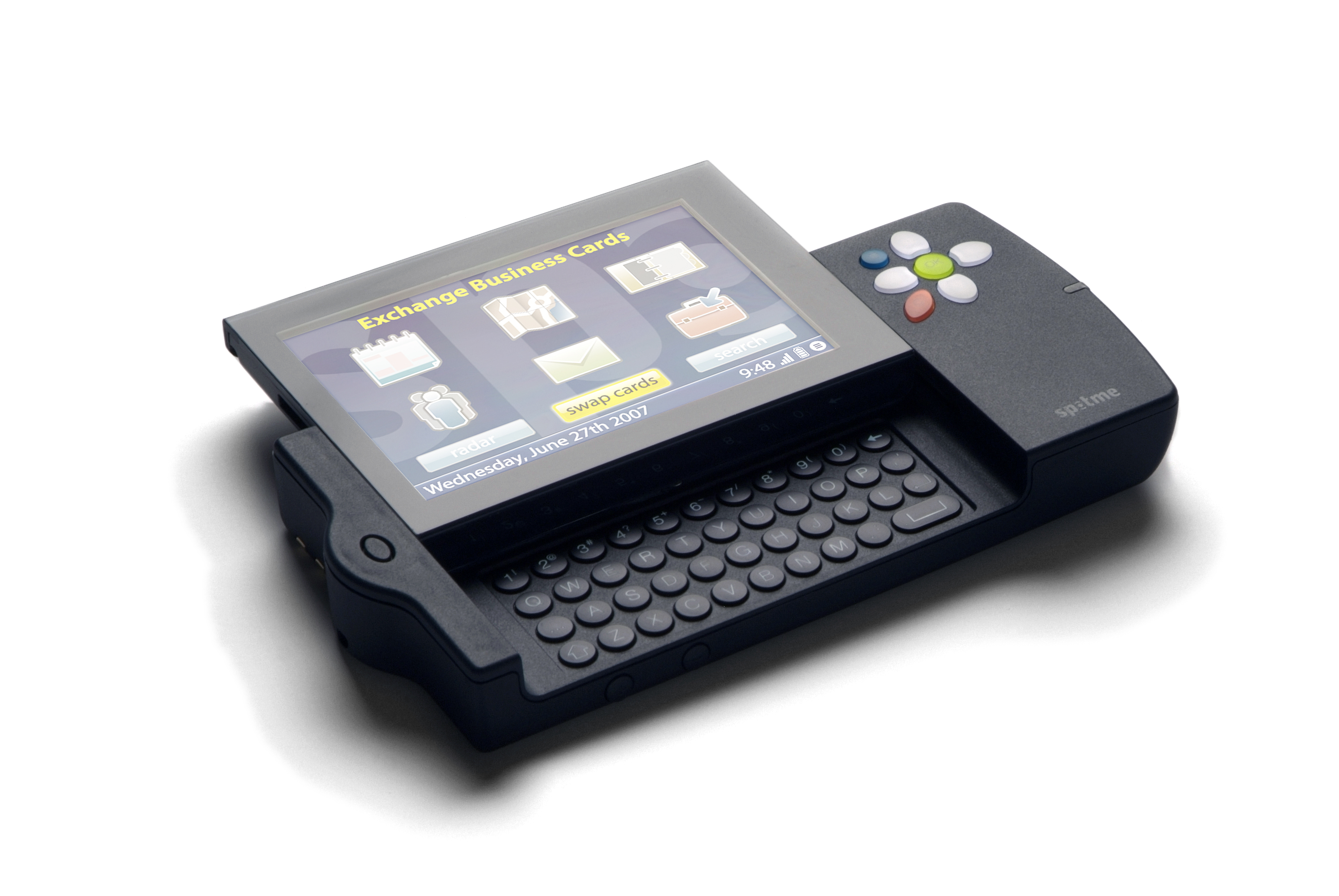
In a room of 1,000 people, it is hard to meet and obtain information about others. There is a new device that will solve this problem.
A Swiss company has designed a portable wireless contace manager called Spotme. Many European countries are using this device to allow attendees to experience technology and convenience throughout meetings. It is specifically designed to be used at conferences with more than 1,000 participants. Spotme is part messaging tool and part peoplefinder with program-at-a glance and voting capabilities to boot. According to the website, “Spotme combines audience response, Q&A sessions, messaging, lead retrieval, social networking, attendance tracking, and electronic feedback forms to create the only all-in-one communication service for events.”
By using Spotme, the meeting planner can easily modify brochures and pamphlets and people will immediately be notified. There is no hassle when trying to receive feedback. It has a color screen, keypad, and wireless microphone and speaker. It eliminates the need for lengthy brochures and schedules at exhibitions. Its memory consists of 1MC Flash and 8MB DRAM. It is the perfect size for one meeting. The participant can also take notes on Spotme. Map of the meeting room and conference agendas are also provided. The best part of Spotme is that it does not take more than five minutes to learn how to use it.
For networking, the device identifies other attendees through a searchable photo database, allows participants to send messages to each other, and can exchange business cars that load into Outlook or a PDA. When you go home, it is hard for you to remember people that you have collected business cards from. Pictures are shown with the profile, so the participants can easily identify each other. It can also mark people that the participant wants to meet. When the marked person is within a 10m radius, the Spotme alerts the user and a photo pops up.
Subscribe to:
Posts (Atom)